
More Recipes
- Thai Chicken Meatballs
- World's Best Lasagna
- Chipotle Style Burrito Bowl
- Choux Pastry- Chocolate Eclairs and Profiteroles
- Pasta Salad with Corriander and Lime Dressing
- Croissant Dough- Ham and Cheese Croissants and Pain au Chocolat
- Crispy Pork Dumplings
- Grilled Chicken Souvlaki
- Grilled English Peas
- Roast Chicken with Couscous
- Carrot Cupcakes with Cream Cheese Icing
- Poached Chicken Salad with Peanut-Lime Dressing
- Bittersweet Chocolate Souffles with Vanilla Creme Anglaise
- Pan-Seared Scallops with Prosecco Butter Sauce
- Penne Pasta with With Roasted Garlic Tomato Sauce and Italian Sausage
- Pavlova
- Chicken Enchiladas
- Creme Brulee
- Chicken Jalfrezi
- Chocolate-Orange Pot de Creme
- Harissa Chicken witch Couscous Salad
- Oven Roasted Cauliflower
- Grilled Spiced Chicken with Lemon and Thyme
- Rasta Basta
- Neopolitian Pizza Dough
- Afghan Biscuits
- NY Style Pizza Sauce
- Chicken Balti
Croissant Dough- Ham and Cheese Croissants and Pain au Chocolat
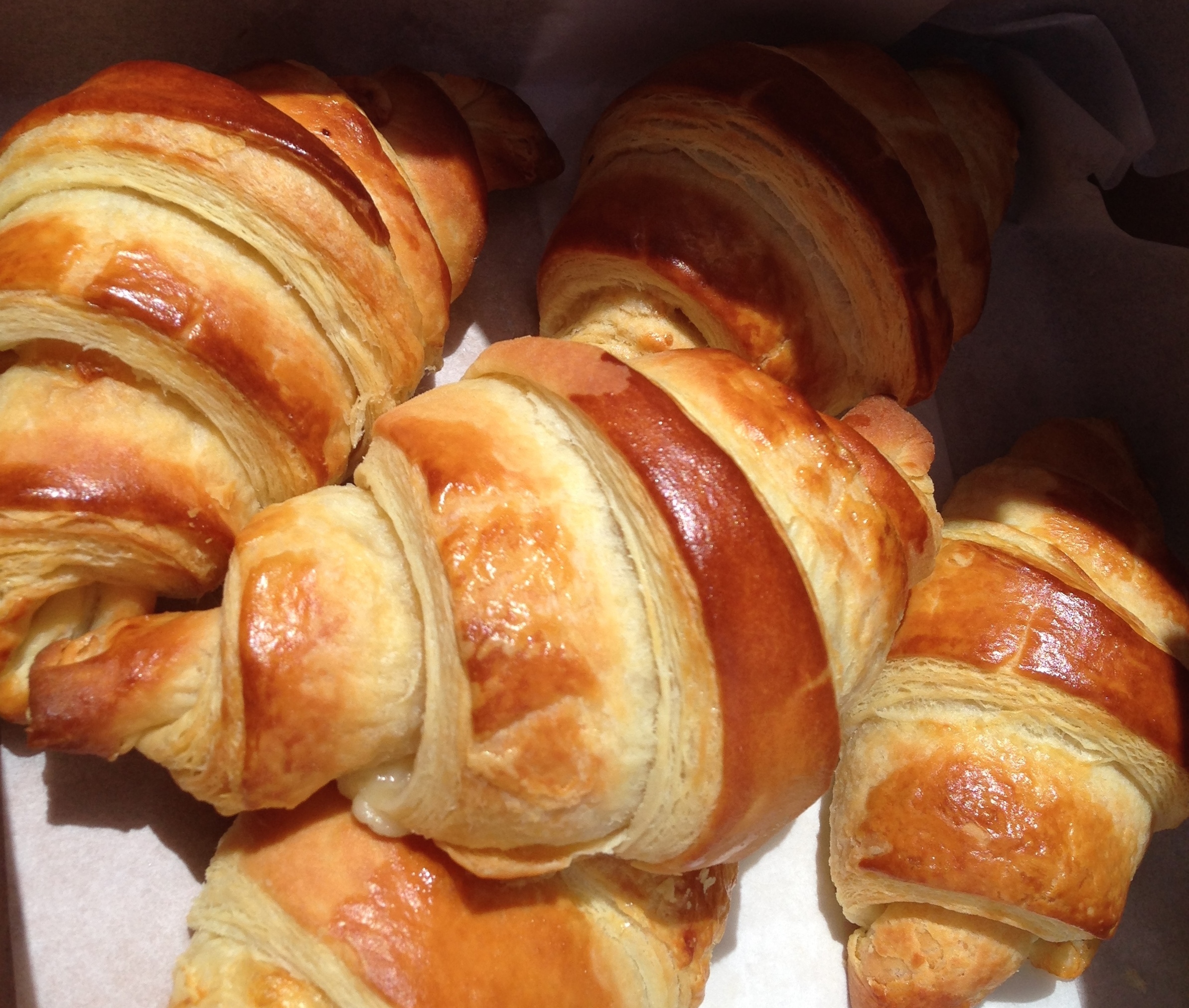
Serves 24
Croissant dough- Plain Croissants
- 1/4 cup warm whole milk
- 1 teaspoon plus 2 tablespoons sugar
- 4 teaspoons active dry yeast
- 4 cups unbleached all purpose flour
- 2 teaspoons salt
- 1/4 cup(57g) cold unsalted butter, cut into small pieces
- 1 cup cold milk
- 397g(3 1/2 sticks) cold unsalted butter
- 2 tablespoons unbleached all purpose flour
- 1 large egg
- 1 tablespoon whole milk or cream
Make the dough block
- Pour the warm milk into a small bowl and whisk in 1 teaspoon of the sugar. Whisk in the yeast and set aside for 10 minutes, or until the yeast is activated and the mixture is bubbling.
- In the bowl of a stand mixer fitted with a paddle attachment, combine flour, remaining 2 tablespoons of sugar, the salt and the cold butter pieces. Blend on medium seed until the butter is cut into tiny pieces and the mixture resembles bread crumbs. Add the yeast mixture and the cold milk. switch to a dough hook and mix on the lowest speed for 1 1/2-2 minutes, until the liquid is absorbed and has formed a very rough mass. Dust a work surface lightly with flour and turn the dough out onto it. Knead the dough 3 to 5 times, just to bring it together. The dough will not be smooth or elastic; it will become fully kneaded and smooth during the rolling and turning process ahead. Don't overwork the dough now or you'll have trouble rolling it later. Wrap the dough loose in plastic wrap (allowing a little room for expansion) and refrigerate for 30-60 minutes.
To prepare butter block
- Cut the butter into 1.3cm pieces, toss with the flour and refrigerate for 20 minutes. In the cleaned stand mixer fitted with the paddle attachment, beat the floured butter on medium speed, scraping down the bowl once or twice with a bowl scraper, for 1 to 2 minutes, until the butter and flour form a smooth mass. You are not trying to beat air into the mixture, just make it pliable and smooth while keeping it cold. Scrape the butter onto a piece of parchment paper or plastic wrap, wrap it up and refrigerate while you roll out the dough.
To incorporate the butter into the dough
- Dust the work surface with flour. Set the dough in the centre and dust the top with flour. Roll the dough into a 15x12 inch rectangle with a short side parallel to the edge of your work surface. Gently pull or stretch the dough to form straight edges and sharp corners. Brush any flour from the surface. Visually divide the dough crosswise into 3 equal 5 inch wide sections (you can lightly mark with a ruler or the back of a knife if you wish). Spread the cold but pliable butter evenly over the top two sections of dough, leaving the bottom third empty and leaving a 1/2 inch border around the edges of the buttered sections. This is best done with your fingers, since the butter isn't quite warm enough to spread easily with a spatula. Alternatively, you can place the butter between two sheets of plastic wrap and roll it into a 9 1/2 by 11 inch rectangle. Peel off one sheet of plastic, invert the buttered rectangle over the dough rectangle, centre it and peel of the other sheet of plastic
To encase the butter with a letter fold
- Fold the empty bottom third up over the centre third of the dough. Then fold the top third down over the centre. Pinch together the seams along the bottom and sides of the dough. Roll your rolling pin across the top briefly and gently 3-4 times to help seal the seams. This completes both the incorporation of the butter and your first turn of the dough. If the butter has become warm and squishy, wrap the dough in plastic wrap and refrigerate for 1 hour before continuing with the second turn. If you have worked quickly and the butter is still cold yet pliable, continue with next turn.
- Position the dough with the short side parallel to your work surface and the long fold on your left. Dust with flour and roll it into 20 by 12 inch rectangle. Brush any flour from the surface of the dough. Fold the dough using the book fold method; Fold the two short edges into the centre of the dough, leaving a 1/4 inch crevice between them. line up the edges precisely and square the corners as you fold. Now fold one side over the other, as though you were closing a book. Roll your pin across the top of the dough briefly and gently 3-4 times to seal the seams. this completes your second turn. Wrap the dough and refrigerate for 1 hour.
- Remove the dough from the refrigerator, dust with flour and roll again into a 15 by 12 inch rectangle. Brush any flour from the surface of the dough. Fold the dough using the letter fold method; visually divide the dough lengthwise into 3 equal, 5 inch wide sections. Fold the bottom third up over the centre third of the dough, making sure to square the corners and fold as neatly and precisely as possible. Roll your rolling pin across the top of the dough again to help seal the seams. This completes your third turn. The croissant dough is finished. Wrap in plastic wrap and refrigerate for at least 2 hours and up to 24 hours before cutting, shaping and baking the dough.
To cut the dough
- Roll the dough on a floured surface into a 26 by 14 by 1/4 inch thick rectangle. Cut the rectangle in half lengthwise to from two pieces that each measure 26 by 7 inches. Position the rectangles so the long edges are parallel to the edge of your work surface.On each piece, use a ruler and paring knife or pizza cutter to make nicks along the top edge of the dough every 4 inches. Along the bottom edge, measure 2 inches in from the left side and make a nick; then nick every 4 inches after that.
To cut the dough into triangles
- Line up your ruler with the top left corner and the first bottom nick (2 inches in from the left side of the dough). Cut along this line. This first skinny triangle is not a full croissant. You can use these "scrap" pieces to make baby croissants or simply sprinkle the surface with sugar and bake as a snack. Next, line up the ruler with the first nick on the top edge and the left corner bottom, and cut along that line, forming a full size triangle. Then cut a line from the first nick on top to the first nick on bottom to form the second triangle. Continue lining up the nicks and cutting until the whole sheet has been cut into 12 triangles. Mark and cut the second half of the dough in the same way.
To shape the dough
- Line the baking sheets with parchment paper or silicone mats. line up all the triangles so that their bottom sides are parallel to the edge of your work surface. Make a 1 inch vertical slit in the centre of the bottom edge of each triangle. To shape, grasp a triangle and, with the wide end in one hand and the point in the other, very gently stretch the dough until it is a couple of inches longer. Set it back on the table (notice how it resembles the Eiffel tower!). Pull the slit in the bottom apart slightly and roll the corners, upward and outward, widening the slit. Roll the entire triangle toward the tip, pulling gently on the tip to stretch the dough slightly. Tuck the tip under the roll (so it doesn't pull out during baking) and place the roll on one of the prepared baking sheets. Curve the ends in toward each other to for a crescent shape. Continue stretching and rolling the dough triangles until you have shaped all the croissants and placed them 2 inches apart on baking sheets.
To wash with egg and proof
- Lightly beat the eggs and milk in a cleaned small bowl. Brush each croissant evenly with the egg wash. Cover the remaining egg wash and refrigerate for use later. Allow the croissants to rise in a cool room-temperature spot until they are nearly doubled in size, 1-2 hours depending on the warmth of the room. If you squeeze one gently, it should feel soft and marshmellow like. Don't try and rush the rise by warming the croissants- you don't want the butter to melt.
To bake the croissants
- Preheat the over to 200 degrees C and place a rack in the centre. Chill the croissants in the freezer for 10 minutes or in the refrigerator for 15 minutes. This will firm the butter, creating a flakier texture. Brush the croissants once more with the egg wash. Bake one baking sheet at a time, rotating it halfway through, for 17-22 minutes, until the croissants are a deep golden brown. Transfer the croissants to a rack to cool. Enjoy!
Pain au Chocolat
- Croissant dough (See above)
- 1 cup finely grated semi-sweet or bitter-sweet chocolate
- 2 tablespoons icing sugar
- 1/4 cup finely chopped semi-sweet or bitter-sweet chocolate
Prepare the croissants
- Use the recipe above to prepare the croissant dough. During the shaping process, after the dough is cut into triangles place 2 teaspoons of the grated chocolate 1/2 inch from the bottom of each triangle. Use a spoon to gently push the chocolate into the shape of a small triangle, keeping it centred on the dough and away from the edges. Continue to prepare and bake the dough as above.
To decorate
- With a fine mesh strainer, dust the top of the croissants with the icing sugar. melt the chopped chocolate until smooth and liquid. Transfer to piping bag fitted with a small #2 tip, and pip the melted chocolate over the croissants. Enjoy!
Ham and Cheese Croissants
- Croissant dough (See above)
- 6 thin slices ham, each quartered
- 1 1/2 cups grated swiss or cheddar cheese
Prepare the croissants
- Use the recipe above to prepare the croissant dough. During the shaping process, after the dough is cut into triangles roll or fold a piece of ham so that it is smaller than the width of the croissant base. Place the ham about 1/2 inch from the bottom of each triangle. Sprinkle 1 tablespoon of grated cheese on top of the ham. Take care not to spill when rolling. Continue to prepare and bake the dough as above. Enjoy!